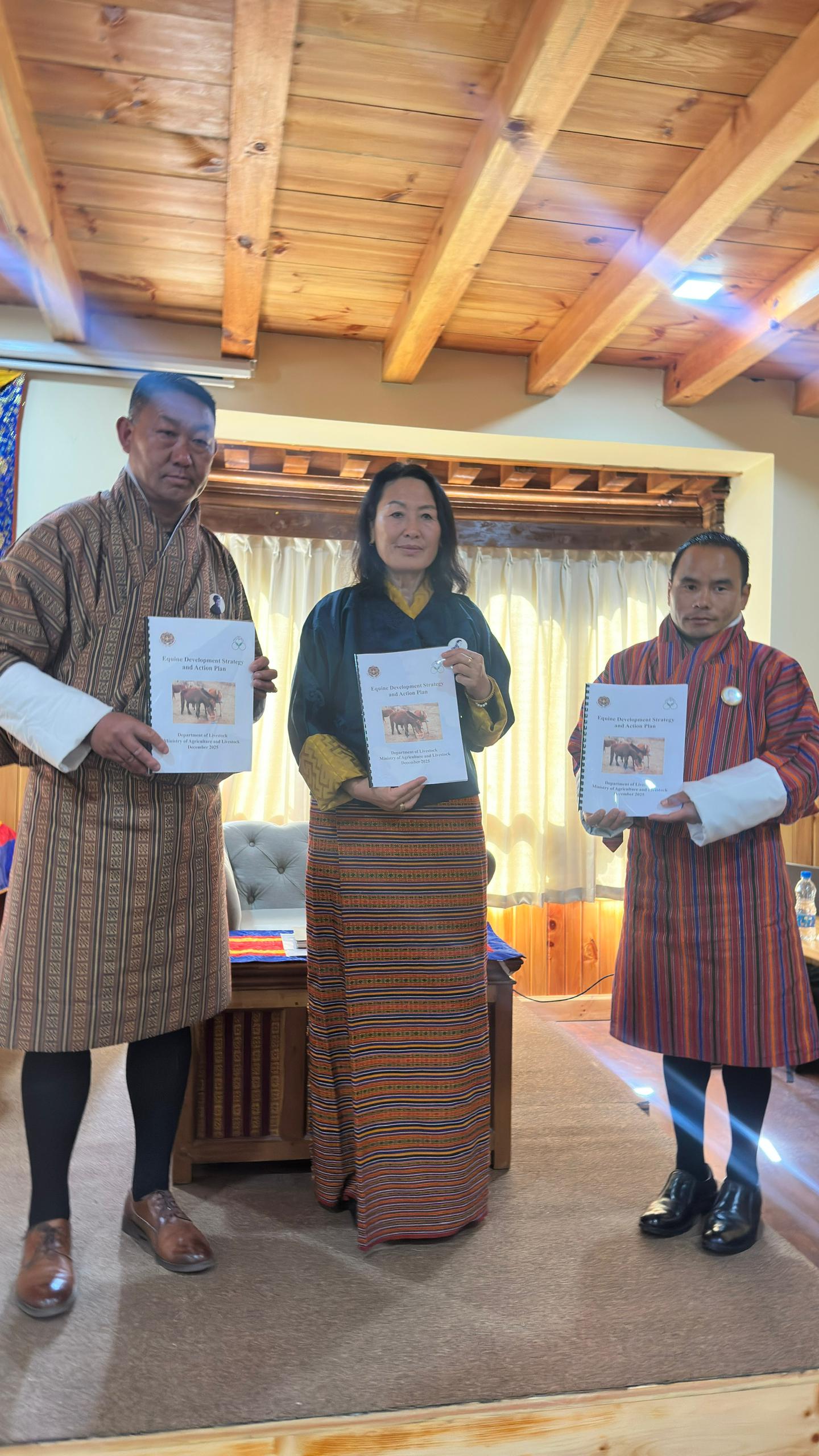
The Department of Livestock (DoL), Ministry of Agriculture and Livestock, has launched the Equine Development Strategy and Action Plan 2025, aimed at revitalizing Bhutan’s equine sector and conserving indigenous horse breeds.
Bhutan’s equine population has declined from 24,333 in 2006 to 10,499 in 2024, representing an average annual decrease of 4.9 percent over the last 18 years. Officials attribute the decline largely to expanding road connectivity and reduced reliance on equines for transport.
Despite this trend, equines remain important for eco-tourism, highland livelihoods, and religious and cultural ceremonies, particularly in dzongkhags such as Gasa, Thimphu, and Paro, which continue to maintain higher equine populations.
The strategy is implemented through the National Equine Farm (NEF) in Nasphel, Bumthang, which currently manages 84 equines on 57.99 acres of registered land, including 45 acres of improved pasture. The farm maintains local Yuta horses, Spiti horses imported from India, as well as donkeys and mules.
Key interventions under the strategy include genetic improvement through pure-line and crossbreeding, strengthened community-based breeding programs, and enhanced institutional capacity. In July 2024, Bhutan also received 300 doses of frozen Mongolian stallion semen to improve genetic diversity in the national horse population.
By the end of the 13th and 14th Five-Year Plans, the Department aims to increase annual horse production from 5 to 40 animals and mule production from 5 to 25 animals, while maintaining dedicated equines for religious institutions and the Royal stable.
The Equine Development Strategy and Action Plan 2025 is expected to contribute to sustainable livelihoods, preserve Bhutan’s cultural heritage, and ensure a resilient future for the country’s equine sector.