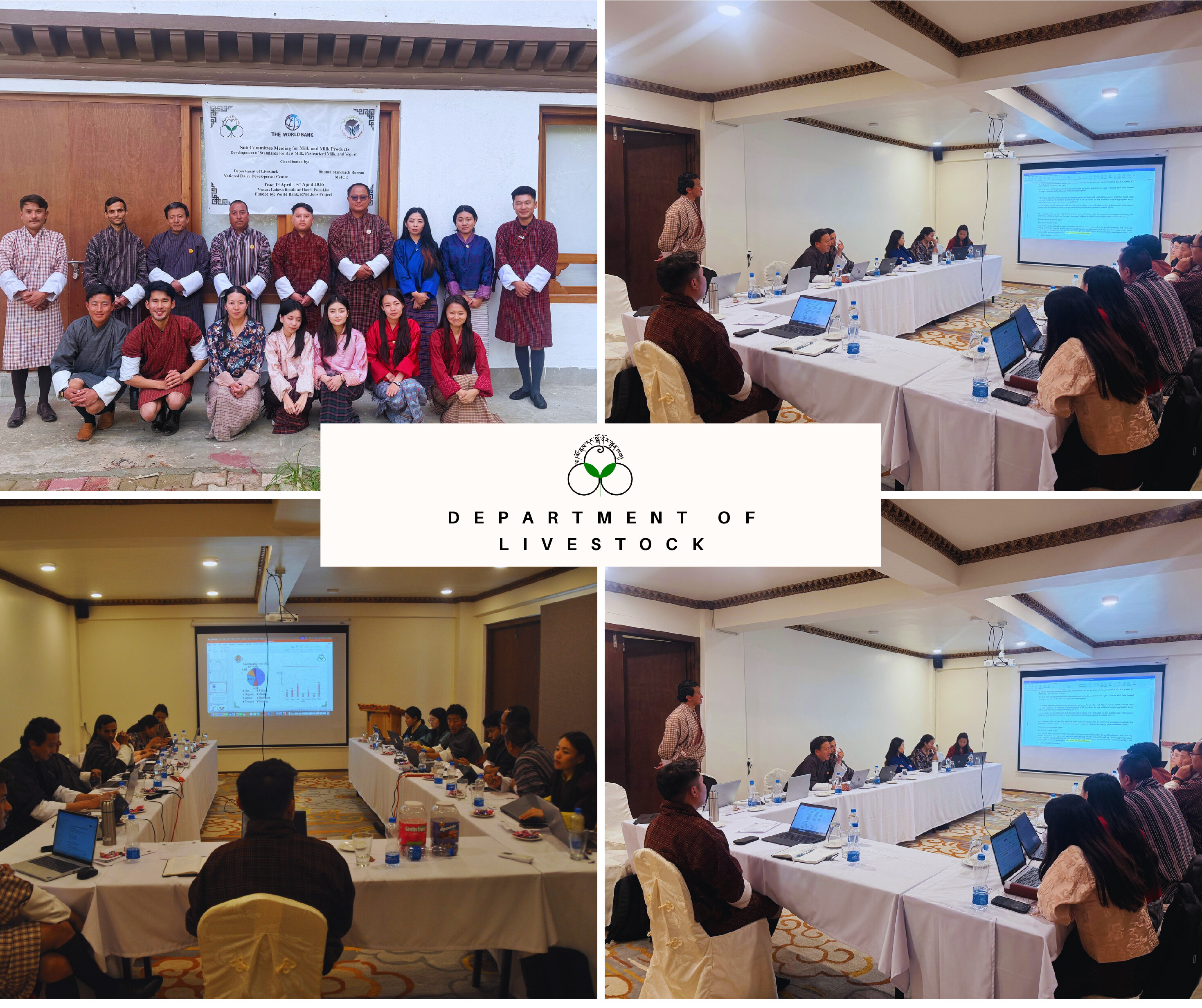
The National Dairy Development Centre under the Department of Livestock, Ministry of Agriculture and Livestock, in collaboration with the Bhutan Standards Bureau under the Ministry of Industry, Commerce and Employment, is currently conducting a five day consultative workshop from 1-5 April 2026 at Lobesa, Punakha. This workshop is being convened through the sub-committee for Milk and Milk Products with the objective of developing National Standards for Raw Milk, Pasteurized Milk, and Yoghurt.
The consultative process brings together a wide range of key stakeholders, including technical experts and officials from the Department of Livestock, Bhutan Food and Drug Authority, Competition and Consumer Affairs Authority, National Post Harvest Centre, Koufuku International Limited, as well as representatives of dairy farmer groups from Thimphu, Chhukha, Wangdue Phodrang, and Trashigang. This inclusive participation ensures that the standards being developed are practical, scientifically sound, and reflective of ground realities across the dairy value chain.
The primary objective of the workshop is to gather comprehensive inputs from all stakeholders and formulate robust and nationally applicable standards for milk and yoghurt. These standards will serve as a critical foundation for improving the overall quality, safety, and consistency of dairy products in the country. By clearly defining parameters for production, handling, processing, and marketing, the standards will promote hygienic practices across the entire dairy value chain, from farm to consumer.
Importantly, this initiative builds on the progress already made by the Centre, where National Standards for cheese and butter have been developed. The current effort therefore represents a continuation and strengthening of Bhutan’s broader agenda to establish a comprehensive standards framework across all major dairy products. The development of these standards is strategically aligned with the priorities of the 13th Five Year Plan of the Department of Livestock, which 𝐞𝐧𝐯𝐢𝐬𝐢𝐨𝐧𝐬 𝐭𝐡𝐞 𝐢𝐧𝐭𝐫𝐨𝐝𝐮𝐜𝐭𝐢𝐨𝐧 𝐨𝐟 𝐚 𝐪𝐮𝐚𝐥𝐢𝐭𝐲 𝐛𝐚𝐬𝐞𝐝 𝐦𝐢𝐥𝐤 𝐩𝐫𝐢𝐜𝐢𝐧𝐠 𝐬𝐲𝐬𝐭𝐞𝐦 𝐢𝐧 𝐭𝐡𝐞 𝐜𝐨𝐮𝐧𝐭𝐫𝐲. Under this system, the price that farmers receive will be determined by the quality of milk they produce, rather than solely by the volume supplied. This marks a significant shift towards a more performance driven and quality oriented dairy sector.
The establishment of clear national standards is therefore a prerequisite for the successful implementation of such a pricing mechanism. Without standardized benchmarks for quality parameters such as hygiene, composition, and safety, it would not be possible to ensure fairness, transparency, and consistency in milk grading and pricing. These standards will enable objective assessment of milk quality, thereby ensuring that farmers who invest in better practices receive higher returns.
At the same time, the introduction of standards will directly benefit consumers by ensuring access to safe, hygienic, and high quality milk and milk products. This will strengthen consumer confidence in domestically produced dairy products and contribute to improved public health outcomes.
In the broader context, the development and enforcement of National Standards for milk and yoghurt will play a transformative role in advancing the commercialization of the dairy sector. It will support product diversification, enhance value addition, and reduce dependence on imports by strengthening the competitiveness of locally produced dairy products. Ultimately, this initiative represents a critical step towards building a modern, resilient, and quality driven dairy industry in Bhutan.
𝐓𝐡𝐢𝐬 𝐢𝐧𝐢𝐭𝐢𝐚𝐭𝐢𝐯𝐞 𝐢𝐬 𝐛𝐞𝐢𝐧𝐠 𝐢𝐦𝐩𝐥𝐞𝐦𝐞𝐧𝐭𝐞𝐝 𝐚𝐬 𝐩𝐚𝐫𝐭 𝐨𝐟 𝐭𝐡𝐞 𝐖𝐨𝐫𝐥𝐝 𝐁𝐚𝐧𝐤 𝐟𝐮𝐧𝐝𝐞𝐝 𝐑𝐍𝐑 𝐉𝐨𝐛𝐬 𝐏𝐫𝐨𝐣𝐞𝐜𝐭.
𝘙𝘦𝘱𝘰𝘳𝘵𝘦𝘥 𝘣𝘺: 𝘕𝘋𝘋𝘊, 𝘠𝘶𝘴𝘪𝘱𝘢𝘯𝘨